Many overseas B2B brands struggle when they try to enter China. They often rely on a single channel, copy Western SEO tactics, or treat WeChat as just another newsletter tool. This approach almost never works.
China is a different digital universe. Baidu dominates search. WeChat is the everyday operating system for professionals. And now, generative AI engines like Baidu’s Wenxin Yiyan (ERNIE Bot) are changing how buyers find and trust suppliers.
For B2B brands planning to enter China, the proven model is a four‑pillar strategy: PPC + SEO + WeChat Operations + GEO, with your Chinese website and WeChat official account acting as the dual traffic closure points.
This article walks you through the entire framework – from infrastructure to long‑term conversion – in a way that is actionable and search‑engine friendly.
Part 1: The Foundation – Build Your Two Core Assets
Before you drive any traffic, you need two reliable homes for your audience.
1.1 A Fully Localized Chinese Website
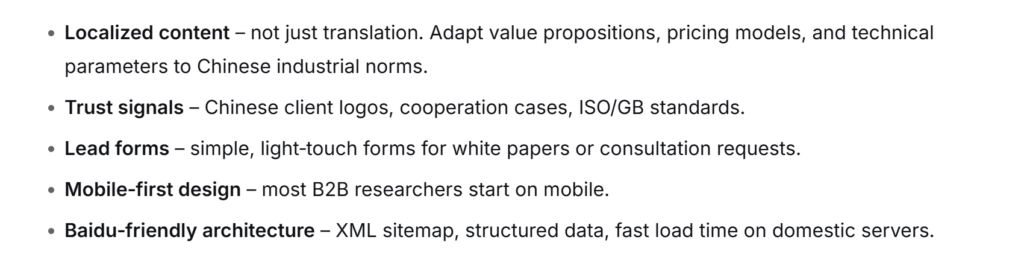
Your global website is not enough. Chinese B2B buyers expect local language, local case studies, local certifications, and fast hosting within China. A high‑conversion B2B China website must include localized content that adapts value propositions, pricing models, and technical parameters to Chinese industrial norms. It also needs strong trust signals, such as Chinese client logos, cooperation cases, and references to local standards like GB or ISO. Lead forms should be simple and light‑touch, designed for white paper downloads or consultation requests. Because most B2B researchers start their journey on mobile, a mobile‑first design is non‑negotiable. Finally, the website architecture must be Baidu‑friendly, with an XML sitemap, structured data, and fast loading times on domestic servers.
1.2 A WeChat Official Account (Service Account)
For B2B, a Service Account is the right choice. It allows advanced APIs, custom menus, and appears directly in the chat list. When setting up the account, you should include a brand introduction and automatic reply, a custom menu that links to key website pages such as case studies and contact forms, and customer service integration. Your WeChat account is not a broadcast tool. It is a relationship‑building channel. Use it to share technical insights, answer buyer questions, and move prospects toward a website visit.
Part 2: The Four Engines – PPC, SEO, WeChat, and GEO
Once your foundation is ready, you activate four parallel channels. Each serves a distinct role, but they work best when coordinated.
2.1 Baidu PPC – Fast, Measurable, and Ideal for Testing
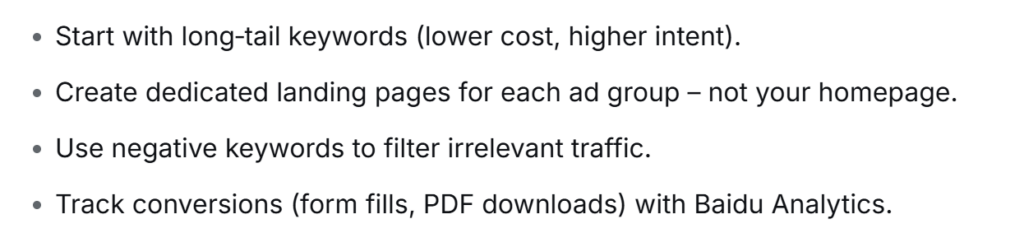
Baidu PPC is the quickest way to appear in front of active B2B buyers. When they search for terms like “industrial pump supplier China” or “automated packaging line cost,” your ad can be the first result. For B2B PPC, best practices include starting with long‑tail keywords because they have lower cost and higher intent. You should create dedicated landing pages for each ad group instead of sending traffic to your homepage. Use negative keywords to filter irrelevant traffic, and track conversions such as form fills and PDF downloads with Baidu Analytics. PPC gives you immediate volume, but it should never be your only channel. Use it to validate keyword demand while SEO builds organic strength.
2.2 Baidu SEO – Long‑Term Asset Building
SEO on Baidu is different from Google. Baidu values domain age and trust, internal linking structure, content from recognized industry sources, and frequent fresh updates. Core SEO activities include keyword mapping to product, problem, and comparison intent. You should publish one to two in‑depth articles per week, covering case studies, technical guides, and industry trends. Building backlinks from Chinese B2B platforms, CSDN, and industry media is also essential. Finally, submit your sitemap to Baidu Webmaster Tools. SEO is a slow burn, but it provides sustainable lead flow at a lower cost over time.
2.3 WeChat Operations – Nurturing and Closed‑Loop Communication
B2B buyers rarely convert on the first visit. They need education and trust. WeChat allows you to stay in front of them without retargeting ads. What should you publish on WeChat? A weekly deep‑dive article (you can repurpose SEO content), client success stories (anonymized if needed), short video clips of product applications, and event invitations for webinars or factory tours. For distribution, rely on employee and sales team sharing on Moments, industry group sharing, and light WeChat ads using lookalike audiences. The goal is not viral reach. The goal is to move a qualified reader from the article to your website or to a direct sales conversation.
2.4 GEO (Generative Engine Optimization) – The New Frontier
Generative AI is changing search. Buyers now ask Deep Seek, Wenxin Yiyan or Doubao: “What are the top three suppliers of industrial sensors in China?” If your brand is not mentioned, you lose trust before the first click. GEO is about becoming the source that AI engines cite. To optimize for GEO, you should publish FAQ‑style content that directly answers common B2B questions. Use structured data (schema) on your website. Write clear, authoritative, fact‑based definitions such as “A servo press is …” and include your brand name alongside technical explanations. GEO builds brand authority in the AI layer. It increases branded search volume and improves conversion quality because buyers arrive already informed.
Part 3: Traffic Closure – How the Website and WeChat Work Together
All four channels – PPC, SEO, WeChat content, and GEO – must lead somewhere. You need a dual closure system: the website for high‑intent conversions, and WeChat for mid‑funnel nurturing.
3.1 Website as the Primary Conversion Hub
When a visitor clicks a Baidu ad or a search result, they land on a specific page designed to close them. For effective closure, match landing page copy to the keyword they searched. Place forms above the fold on both desktop and mobile. Offer a clear next step, such as “Download specification” or “Request a quote.” Use heatmaps and A/B testing to improve form conversion rates. Every website visitor who leaves a contact becomes a sales‑ready lead, and you can then sync this data to your CRM.
3.2 WeChat as the Relationship and Retargeting Channel
Not all visitors are ready to fill a form. They might read an article and leave. That is fine – if you have WeChat. How does WeChat close the loop? New followers receive an automated welcome message with a link to key resources. The custom menu guides users to “Request a quote” or “Download case study.” You can push new content to followers weekly, staying top‑of‑mind. Sales teams can use WeChat to send files, voice messages, and meeting invitations directly. WeChat is where long B2B sales cycles play out. The website captures the lead; WeChat cultivates it.
Part 4: A Realistic 12‑Month Roadmap
Most B2B brands underestimate the time required. Here is a phased plan.
During months one and two, focus on infrastructure. Build your Chinese website, and complete Baidu verification. Create your WeChat Service Account with a menu and auto‑reply. Write the first ten to fifteen SEO articles and four WeChat posts. Set up your GEO foundation by adding FAQ pages and structured data.
During months two and three, move to testing. Launch a small‑budget Baidu PPC campaign with ten to twenty keywords. Publish your first WeChat articles to existing followers, including employees and partners. Monitor GEO mentions by using AI search queries.
During months three to six, expand your efforts. Increase your PPC budget based on the best‑performing keywords. Double your SEO content output to reach over forty articles. Add WeChat advertising for industry audiences. Optimize your FAQ content for generative AI engines.
During months six to twelve, focus on stabilization and optimization. Build a data dashboard that links Baidu, WeChat, and your CRM. Reduce PPC spend on keywords that now rank organically. Launch advanced GEO tactics, such as AI‑friendly knowledge graphs. Begin A/B testing landing pages for higher conversion rates.
Part 5: Key Performance Indicators (KPIs) for Each Channel
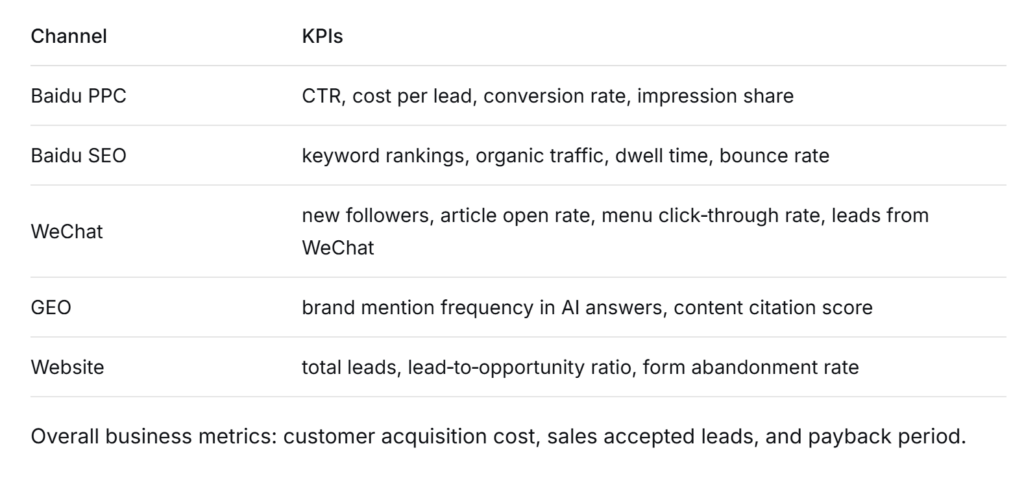
You cannot improve what you do not measure. For Baidu PPC, track click‑through rate, cost per lead, conversion rate, and impression share. For Baidu SEO, monitor keyword rankings, organic traffic, dwell time, and bounce rate. For WeChat, measure new followers, article open rate, menu click‑through rate, and leads generated directly from WeChat. For GEO, watch your brand mention frequency in AI answers and your content citation score. For your website, track total leads, lead‑to‑opportunity ratio, and form abandonment rate. On a business level, keep an eye on customer acquisition cost, sales accepted leads, and payback period.
Part 6: Common Risks and How to Mitigate Them
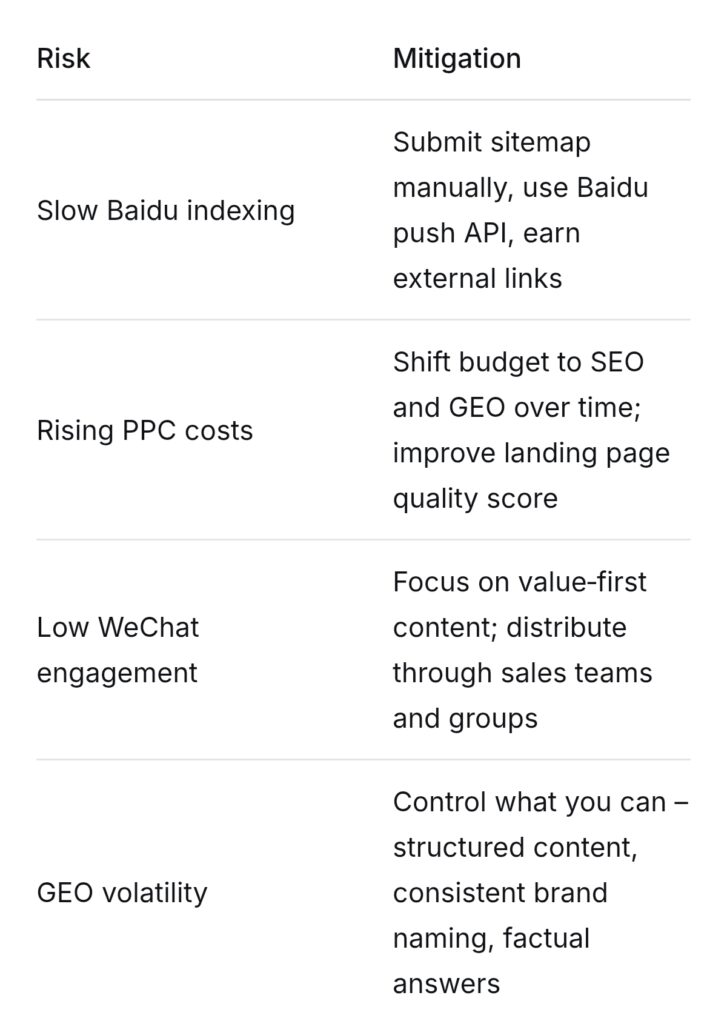
One common risk is slow Baidu indexing. To mitigate this, submit your sitemap manually, use the Baidu push API, and earn external links. Another risk is PPC conversation rate. You should improve your landing page quality score. Low WeChat engagement is also a concern. Focus on value‑first content and distribute it through sales teams and groups. Finally, GEO volatility can be challenging, but you can control what you can – structured content, consistent brand naming, and factual answers.
Part 7: Real-World Success Cases – From Theory to Tangible Results
Case 1: BoRuiSiKe – Near 5x ROI Through Baidu PPC
UE Online, a division of United Electric Controls. Their goal was straightforward but ambitious: build brand recognition outside their dominant industries and generate a steady stream of qualified leads.
They implemented a comprehensive digital program that mirrors the four-pillar framework. They built a fully localized Chinese website as the central hub, launched Baidu search ads and Baidu display ads for immediate visibility, and established a WeChat organic profile complemented by WeChat ads for nurturing.
The results speak for themselves. Since the program began in 2021, UE Online has averaged forty new leads per month directly from their website. Monthly reports consistently show over nine hundred industry-relevant new users engaging with their content. The key to success was recognizing that marketing in China works fundamentally differently than in the United States – and committing to a tailored, channel-integrated approach rather than a one-size-fits-all strategy.
Takeaway for B2B brands: A localized Chinese website is not optional. It serves as the central hub where traffic from Baidu ads, organic search, and WeChat all converge. Without this anchor, leads from different channels cannot be captured or nurtured effectively.
Case 2: Hunan AGV Manufacturer – GEO Cuts Customer Acquisition Cost by 74%
Perhaps the most striking evidence of GEO’s transformative potential comes from a AGV (Automated Guided Vehicle) equipment manufacturer. In the B2B industrial equipment space, Baidu PPC keyword costs for high-value products can be astronomical – often reaching ¥80,000 to ¥120,000 per qualified lead.
Facing these prohibitive costs, the company turned to GEO instead of doubling down on paid search. They build a structured knowledge graph around their AGV products, optimized technical content for AI search engines, and ensured their brand information was consistently presented across platforms like DeepSeek, Kimi, and Baidu’s Wenxin Yiyan.
The results were dramatic. Within four months, customer acquisition cost dropped from ¥80,000 to just ¥21,000 – a 74 percent reduction. Even more impressively, the company achieved total orders of ¥25.5 million during the same period. The key insight from the campaign was that AI-driven search delivers fundamentally different traffic than keyword-based PPC. While only about 10 percent of PPC clicks come from genuine buyers, AI search traffic showed an intent rate of 65 percent. Moreover, the GEO content continued to generate 15 to 20 qualified leads per month even after active optimization ended – a testament to the long-term asset value of GEO.
Takeaway for B2B brands: GEO is not a replacement for PPC or SEO, but a complementary layer that captures high-intent buyers at the very top of the funnel. For high-ticket B2B products, the reduction in customer acquisition cost alone can justify the investment.
Conclusion: Start with the End in Mind
Entering China as a B2B brand is not about running a few ads or opening a WeChat account. It is about building a coherent system where PPC buys you time, SEO builds you assets, WeChat nurtures relationships, and GEO protects your brand in the AI era. Your Chinese website and WeChat official account are not optional. They are the two doors through which every qualified lead should pass. If you take one thing away from this article, let it be this: do not pick one channel. Build all four, and close traffic through both doors. That is how you win in the world’s most competitive digital market.
