Your customers aren’t searching anymore. They’re asking AI directly. Is your brand part of the answer?
Let me start with a number that every brand owner needs to sit with: By January 2026, China’s generative AI user base reached 515 million people. That’s over half a billion consumers who are now turning to AI as their first stop for information, recommendations, and purchase decisions. More strikingly, 86% of Chinese consumers now use AI tools at least once per week.
The way customers find, evaluate, and choose brands has fundamentally shifted. If your brand isn’t visible in AI-generated answers, you’re invisible to a fast-growing segment of your potential buyers.
The “Traffic Intercept” That’s Already Happening
Here’s what many brand owners don’t realize until they see their own data: Users no longer need to click your website to get your information. AI gives them the answer instantly.
According to IDC data cited in industry reports, global AI search traffic share has exceeded 60% . Meanwhile, over 62% of users who obtain information through AI platforms do not click through to any traditional web pages afterward.
This isn’t a future prediction. This is happening right now.
Traditional marketing still matters. But the center of gravity has shifted. The competition is no longer just about who has the best website or the most ads. It’s about who AI trusts enough to cite.
What Is GEO? (And Why Every Brand Entering China Needs It)
GEO stands for Generative Engine Optimization. The term was formally introduced by researchers from the Indian Institute of Technology Delhi and Princeton University in June 2024. In plain language: GEO helps AI recognize, trust, and cite your content when answering user questions.
Let me show you how fundamentally different this is from what came before:
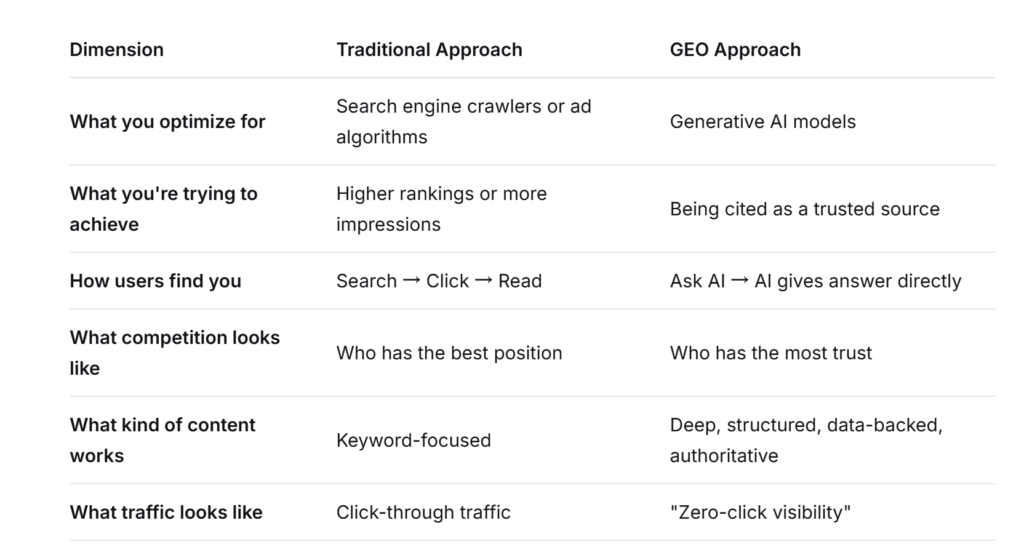
Notice the fundamental shift: You’re no longer competing for a click. You’re competing for cognitive trust – for AI to recognize your brand as the authoritative source worth citing.
The Tipping Point: Major Chinese Companies Are Now Publicly Bidding for GEO
Here’s something that should grab every brand strategist’s attention: A growing list of major Chinese companies have recently posted public tenders for GEO optimization services.
According to publicly available procurement data from Q1-Q2 2026, these companies include
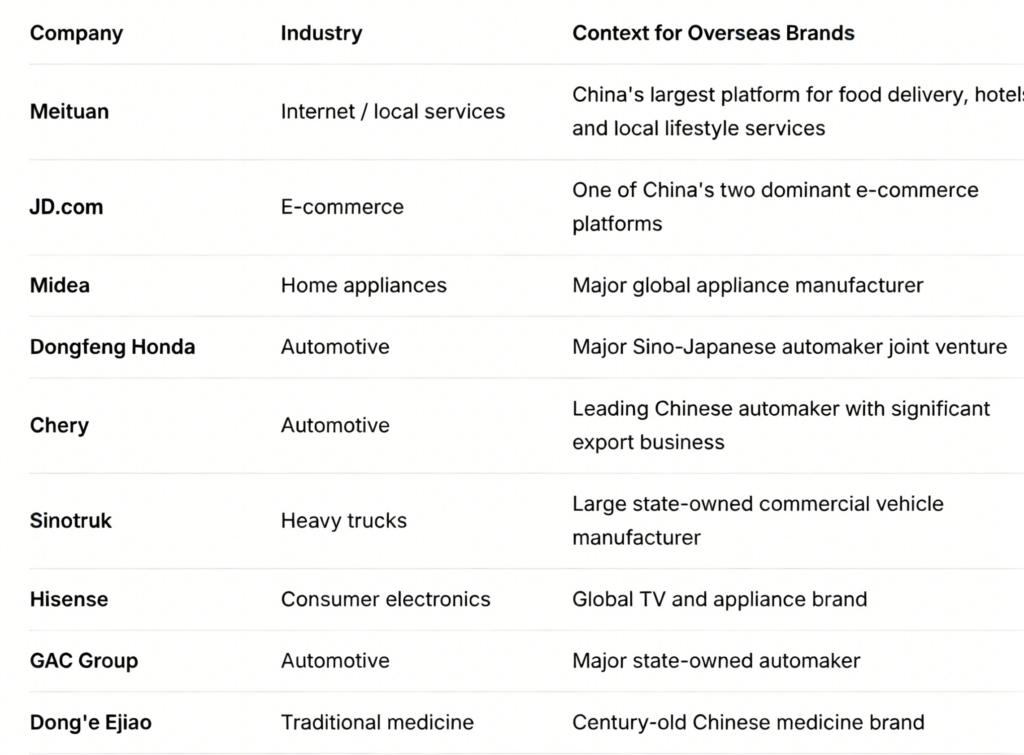
Also included: Tianyi Cloud (China Telecom’s cloud computing arm), Dongpeng Holdings (building materials), Yangtze River Pharmaceutical Group, Wuliangye / Moutai(China’s most famous liquor brands)and others.
Why this matters for overseas brands: When these companies—representing internet platforms, e-commerce, manufacturing, automotive, pharmaceuticals, and state-owned enterprises—all start publicly bidding for GEO services, it’s not a trend. It’s a strategic shift.
These aren’t small startups experimenting with new marketing tactics. These are established enterprises with sophisticated procurement processes. Their collective move into GEO signals that AI recommendation visibility has become a hard business requirement.
What the Bidding Requirements Reveal
Let me show you why these bids are so significant. Consider Dongfeng Honda’s tender requirements as a concrete example:
The automaker explicitly required that on six specified AI platforms – DeepSeek, KIMI, Yuanbao, Doubao, ERNIE Bot (Wenxin Yiyan), and Tongyi Qianwen – their four designated vehicle models must receive consistent, sustained recommendation content for at least 12 consecutive months.
Think about what this means:
It’s platform-specific. Companies have identified exactly which AI platforms matter to their customers.
It’s outcome-based. They want sustained recommendations, not just activity or effort.
It’s measurable. They expect to verify that their products are being recommended when users ask relevant questions.
It’s long-term. This isn’t a one-month test. They’re committing to full-year programs.
Why This Shift Is Happening Now: The Numbers Tell the Story
The data explains why major companies are moving so aggressively:
China’s AI user base reached 515 million people by January 2026. Q1 2026 data shows Chinese AI-native app MAU (monthly active users) reached 440 million, with over 130 million new users added in a single quarter.
The GEO market is exploding. According to multiple industry sources:
2026 domestic GEO market size is projected to exceed 28.6 billion RMB (approx. $4 billion USD), growing 125% year-over-year
Global GEO market reached $22 billion USD in 2026, with China accounting for over 50% of global spending
Industry penetration jumped from 38% in 2025 to 71% in 2026
Over 68% of mid-to-large enterprises have incorporated GEO into annual marketing budgets
AI search traffic converts at 14.2% – approximately 2.5x that of traditional search
The urgency is clear. Analysis shows GEO service revenue grew 320% year-over-year in Q1 2026, while traditional SEO revenue declined 42% during the same period. Over 80% of users now rely on AI-generated summaries when making purchase decisions.
The Cruel Reality: AI Has Built-In Exclusivity
Here’s what makes GEO fundamentally different from every marketing channel that came before:
On traditional search engines, ten different users searching for the same term might see ten different results. There was room for many brands to be considered.
With AI, when a user asks a question, the AI typically returns just 2-3 answers. That’s it.
The answer is either your brand, or your competitor’s brand. There’s no “next page” button. No opportunity to be “also considered.”
This is the brutal math of the AI era: In any given product category, only a handful of brands will be cited by AI. Everyone else becomes invisible at the moment of decision.
Major Chinese companies have recognized this. That’s why they’re not testing GEO – they’re building it into their formal procurement systems.
Real-World Results: What GEO Delivers
GEO isn’t theoretical. Brands implementing GEO are seeing measurable outcomes. Here are verified results from industry sources:
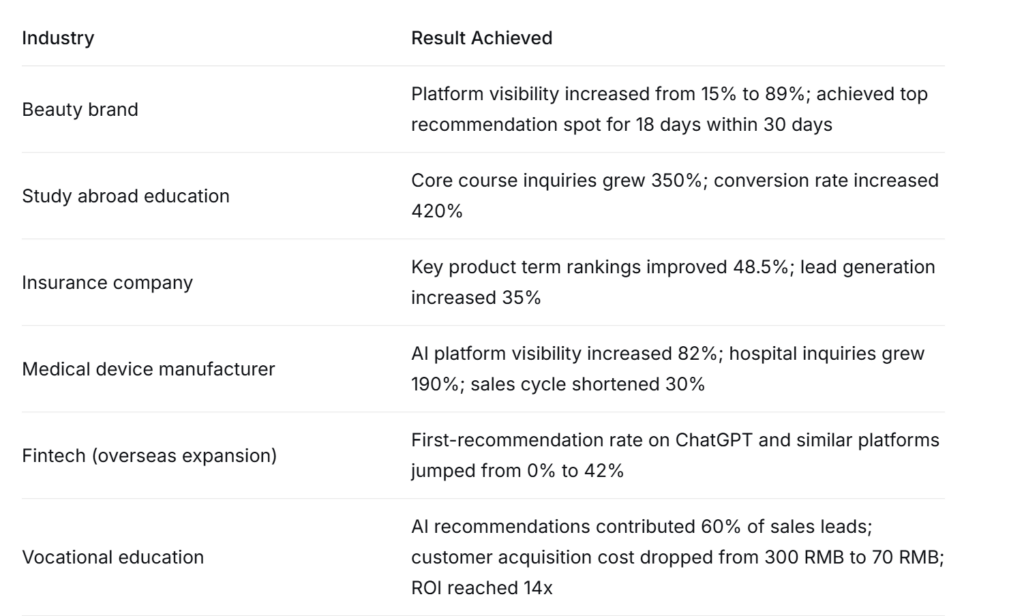
Effective GEO methods improve content visibility by up to 40%. The key is moving beyond keyword density to semantic depth, structured data, and authoritative source signals.
Three GEO Concrete Steps You Can Take Today
1. Shift from “Keyword-First” to “Question-First” Content
AI doesn’t search for keywords. AI answers questions.
What doesn’t work well anymore: Pages built around keyword variations, thin content designed to rank for a specific phrase.
What AI loves to cite: Comprehensive guides that answer real user questions, content with clear structure and original insights, material that demonstrates genuine expertise.
Action step: Audit your content library. For each piece, ask: If a customer asks AI a question related to this topic, would my content be the best answer?
2. Build “Trust Signals” That AI Recognizes
AI evaluates three things before deciding whether to cite you:
Signal 1: Depth of expertise – Does your content offer unique insights, original frameworks, or proprietary data?
Signal 2: Verifiable data – Do you cite specific numbers, case studies, research findings? (e.g., “Service to 100,000+ enterprises” rather than “Loved by customers”)
Signal 3: Third-party validation – Are you cited by other credible sources? Academic papers, industry reports, and respected media all signal authority.
Action step: Publish original research, white papers, detailed case studies, and data-backed trend reports.
3. Test Your Visibility Across Multiple AI Engines
Different AI platforms have different training data and citation patterns. China’s AI landscape includes DeepSeek (the #1 free app on China’s iOS App Store), Doubao(the #1 MAU in China), KIMI, ERNIE Bot (Baidu), Tongyi Qianwen (Alibaba), and Yuanbao (Tencent).
Run this simple audit today:
Ask DeepSeek: “What are the top [your industry] brands for the China market?” – Are you mentioned?
Ask Doubao or KIMI: “Compare [your product category] solutions” – Does your brand appear?
Ask ERNIE Bot or Qianwen: “Recommendations for [your product type]” – Where do you stand?
If AI doesn’t mention you, your GEO hasn’t started.
Why GEO Partner Selection Matters More Than You Think
Here’s a reality check: While over 68% of mid-to-large enterprises have incorporated GEO into their marketing strategy, industry surveys indicate that only a minority of marketing teams truly understand how to execute GEO effectively.
That gap between awareness and capability is where opportunities are made – and where costly mistakes happen.
What separates a reliable GEO partner from an unreliable one:
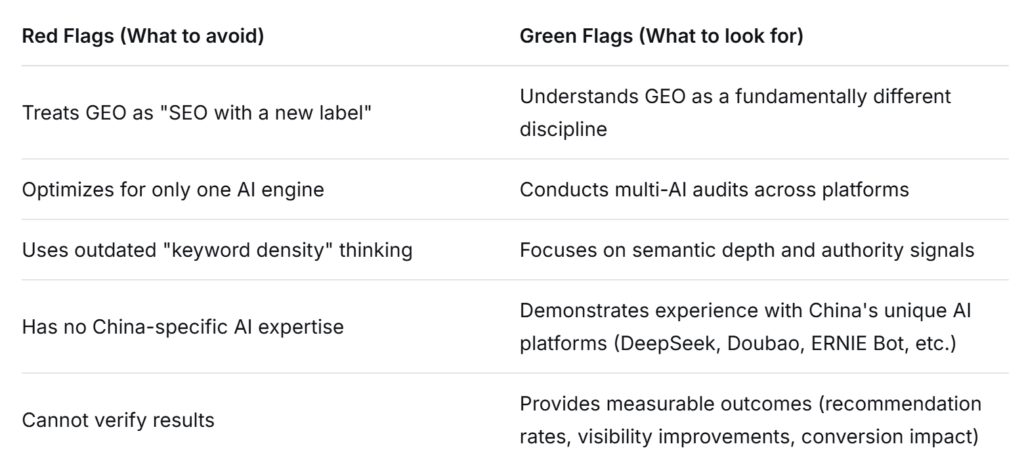
For overseas brands entering China, this is especially critical. China’s AI ecosystem is distinct – with its own leading platforms, content preferences, and user behaviors. A partner who understands both GEO fundamentals and China’s unique AI environment is essential.
The Bottom Line: First-Mover Advantage Is Real
GEO has a characteristic that every smart brand strategist will recognize: strong first-mover advantage.
Once AI identifies your brand as an authoritative source in your field, competitors will need significantly higher investment to displace that recognition. The question isn’t whether GEO will matter – it already does. The question is where your brand will be positioned when your customers ask AI to make a recommendation.
A Final GEO Perspective for Overseas Brands Entering China
China is not just another market. It’s the largest and fastest-growing AI search market in the world, with over 515 million AI users and more than 50% of global GEO spending. Chinese consumers have embraced AI-powered information discovery faster than almost any population on earth.
For overseas brands looking to establish themselves in China, this represents both a challenge and an extraordinary opportunity:
The challenge: Traditional go-to-market strategies are being disrupted faster here than anywhere else.
The opportunity: Because GEO is still new, the window for establishing AI authority is still open – but it won’t stay open forever. The brands that build AI trust now will own that advantage for years to come.
The evidence is clear: When Meituan, JD.com, Midea, Dongfeng Honda, Chery, Hisense, and other major players start publicly bidding for GEO services, the market has spoken. This is no longer experimental. This is the new baseline for competitive visibility.
GEO is no longer a question of “if.” It’s a question of “when.” And the right answer is now.
