
For overseas B2B brands, entering China has traditionally meant a predictable playbook: aggressive bidding on Baidu keywords, expensive trade shows, and relentless outbound sales. But the landscape is evolving. The way Chinese business buyers research and make purchasing decisions has fundamentally shifted.
Consider this: about 72% of B2B buyers now consult AI assistants like Doubao or DeepSeek before making a purchase decision. They no longer rely solely on traditional search engines, they ask AI-powered generative engines specific questions like, “Which ERP software is best for a mid-sized manufacturing company?”
One of our B2B SaaS clients (name withheld at their request) recognized this shift early. They came to us facing rising Baidu advertising costs and inconsistent lead quality. We guided them through a strategic addition to their marketing mix—Generative Engine Optimization (GEO) —and the results within three months were extraordinary.
This post walks through their exact journey, the strategies we implemented together, and provides a practical roadmap for any overseas B2B brand seeking sustainable, cost-effective growth in China.
Why GEO Complements SEO and PPC for B2B in China
Before detailing our process, let’s clarify Generative Engine Optimization (GEO) and how it fits within a balanced B2B marketing mix.
SEO optimizes your website to rank higher on traditional search engine results pages (SERPs) like Baidu or 360
PPC delivers immediate visibility through paid placements on those same search engines
GEO optimizes your content so AI assistants (Doubao, DeepSeek, Qwen, Yuanbao) cite your brand when generating direct answers to user questions
Here’s how we think about the three channels working together:
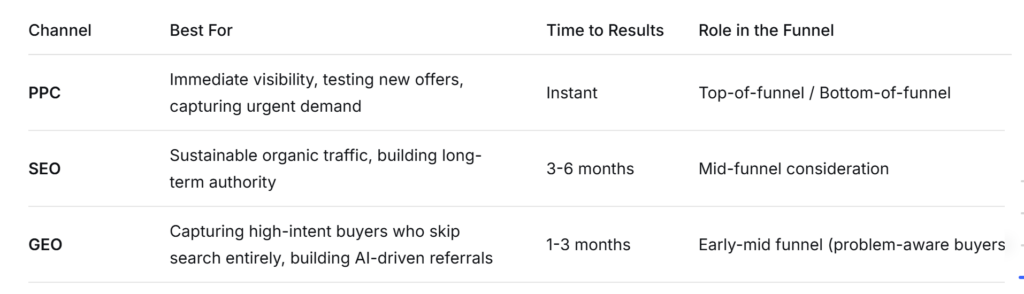
For B2B buyers in China, we’ve found GEO adds a powerful new layer to the traditional search strategy for three reasons:
Changed Buyer Behavior: As noted, nearly 3 in 4 B2B buyers now ask AI for recommendations before contacting a vendor. These buyers may never click a PPC ad or scroll through SEO results—they go straight to an AI conversation.
Different Intent, Different Channel: A user clicking a PPC ad is often early in research. A user asking an AI “Which solution fits my specific problem?” has already defined their need and is closer to a decision. GEO captures this later-stage intent that PPC and SEO may miss.
Cost Synergies: When a prospect encounters your brand through GEO and sees your PPC ads or SEO content, trust and recall increase significantly. The channels reinforce each other.
Our approach with clients is always channel-mix first. We help them allocate budgets across PPC, SEO, and GEO based on their specific goals.
The Challenge: When a Single-Channel Strategy Reaches Its Limits
Our client is a B2B SaaS company selling enterprise management software with a ticket size of RMB 50,000–100,000 (approx. 7,000–7,000–14,000 USD) . By late 2024, they faced a growth challenge familiar to many foreign brands in China:
Rising costs on their existing channels: Their Baidu PPC cost per lead (CPL) had climbed to ¥1,000 as competition intensified
Conversion bottlenecks: Sales teams reported less than 5% conversion from those leads
Budget constraints: Their marketing budget was being reduced, requiring a more efficient channel mix
They had a solid SEO foundation and a well-managed PPC program. But their buyers had started adopting AI assistants as a primary research tool—and their brand wasn’t showing up in those AI conversations.
That’s where GEO came in—as an incremental channel, not a replacement. We proposed adding GEO to their existing mix. Here’s what happened.
The Verifiable Results (3 Months After Our Collaboration)
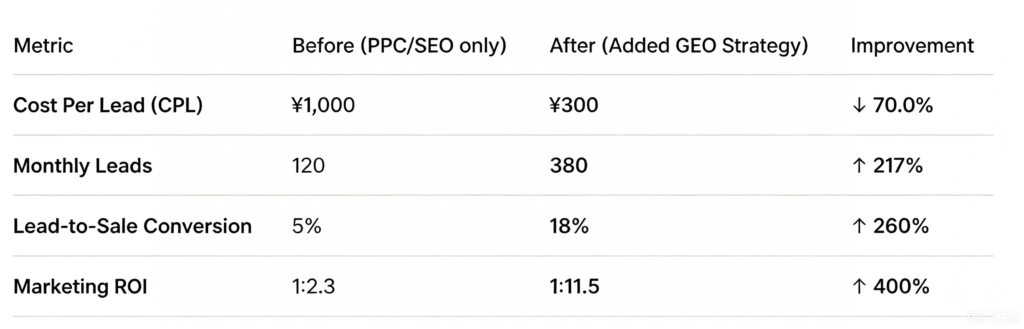
These numbers demonstrate the power of adding GEO to a healthy existing mix. For any overseas B2B brand looking to improve efficiency in China’s competitive digital environment, this is the blueprint we now use with all our clients.
The 5-Step GEO Framework We Used With This Client
Here is exactly how we guided this client through their GEO transformation. Overseas B2B brands can adapt this framework immediately.
Step 1: Building Their AI Question Repository
We started by having their team identify 50 core questions their ideal customers would ask an AI. This is the foundation of any GEO strategy. Categories included:
Product Comparisons: “What’s the difference between Software X and Software Y?”
Needs Matching: “What management software is suitable for a mid-sized auto parts manufacturer?”
Pricing Queries: “How much does enterprise management software typically cost?”
Use-Case Scenarios: “How to solve production scheduling chaos in a small factory?”
Our guidance to them: Use DeepSeek or Doubao to simulate your buyer. Ask it questions and analyze which competitors it mentions. That’s your battleground.
Step 2: Creating High-Quality, AI-Friendly Answer Content
For each of the 50 questions, we help them create a dedicated article (800–1,200 words). We emphasized that content style is critical:
Direct Answers: Get to the point immediately. No fluff.
Structured Format: Use bullet points, tables, H2/H3 headers. AI parsers love structure.
Specific Data: Include prices, feature comparisons, customer case results. Data builds authority.
Natural Integration: Mention your brand as a solution naturally within the answer, not as a hard sell.
Example titles we published:
*2025 ERP Selection Guide for Mid-Sized Manufacturing: 5 Mainstream Products Compared*
*Production Scheduling Chaos? Solve it in 3 Steps + 1 Tool*
Step 3: Optimizing Their Website for AI Crawlers
AI engines scrape websites as one of the primary sources. We audited their site and guided them to optimize these key pages:
Homepage: Add a clear value proposition, target customer avatar, and key data points in plain text
Product Pages: Expand feature lists, use-case scenarios, and integration information
Case Study Page: Restructure client stories with consistent format (Industry > Problem > Solution > Quantified Results)
About Us: Enhance company history, core team expertise, and relevant certifications
The principle: Make it effortless for an AI to understand who you serve, what problem you solve, and why you are credible.
Step 4: Building a Third-Party Content Matrix
AI aggregates information from across the open web. You cannot rely on your website alone. We help them syndicate their core Q&A content across:
Zhihu: The “Quora of China,” highly trusted by AI for expert answers
WeChat Official Account: For in-depth articles and building a professional brand
Industry Media Portals: Guest posts to gain authoritative backlinks
Baidu Zhidao: Answering product-specific questions
The goal we set: Increase their brand’s mention density across high-authority Chinese platforms. The more high-quality, relevant sources cite you, the more likely an AI will choose you as a source.
Step 5: Continuous Monitoring and Optimization
GEO is not “set and forget.” We helped them establish a monthly process:
Weekly AI Testing: Re-ask their 50 core questions to DeepSeeo/Doubao and note how often their brand is cited
Competitor Analysis: Track which competitors appear most often and analyze their content strategies
Feedback Loop: Survey their sales team on which GEO-sourced leads convert best, then create more content on those topics
ROI Tracking: Compare GEO-driven leads against PPC and SEO benchmarks monthly
What You Can Do Starting Next Week
You don’t need a massive budget to begin. Based on what worked for this client, here’s how to test the GEO waters for your brand in China.
Action 1: Audit Your Brand’s Current GEO Status
Open DeepSeek or Doubao and ask:
“[Your product category] which brand is best?”
“Recommend [your product type] for [your target industry].”
“[Target customer profile] what solution is suitable for them?”
If your brand isn’t mentioned, you have a clear opportunity.
Action 2: Create 10 Core Q&A Articles
Take the 10 most common sales questions your team receives. Write an 800-word answer for each. Publish them on:
Your company’s official blog
Your WeChat Official Account
A Zhihu column
Action 3: Clarify Your Website’s Value Signal
Ensure any visitor (or AI bot) can find within 10 seconds on your homepage:
What you do (one clear sentence)
Who you serve (specific industry/title)
Your 3 key differentiators
One powerful customer result (with data)
Conclusion: The Future of B2B Marketing in China is Channel-Mix
The era of relying solely on Baidu keyword auctions or trade shows to reach Chinese B2B buyers is evolving. AI-powered search is becoming a new front door for high-intent buyers. This client case proves that adding a focused GEO strategy to a healthy existing mix can simultaneously lower costs, improve lead quality, and dramatically lift ROI.
For overseas brands, this is an equalizer. You don’t need to abandon your current channels. You need to add a strategic layer—content that answers your buyer’s real questions, structured the way AI engines prefer them—to capture buyers who have moved to AI conversations.
Ready to add GEO to your China marketing mix? Contact us right now!
